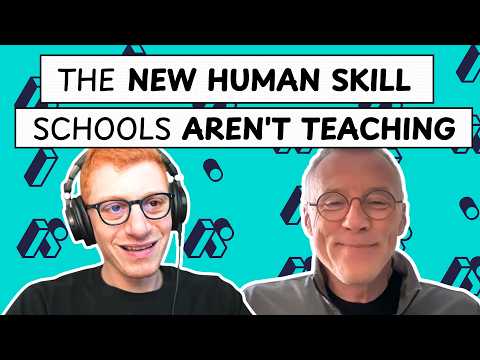
Isabelle Hau: Relational intelligence in an AI-driven world
Bring AI readiness to schools across the country
Free curriculum, tools, and professional development for K-12 educators.
What makes us uniquely human in the age of AI?
According to Isabelle Hau, (Executive Director of the Stanford Accelerator for Learning) it’s our ability to form meaningful relationships — a feat she calls "relational intelligence."
Our conversation with Isabelle explores how education systems need to evolve past measuring success through grades and test scores, and instead toward fostering the human connections that will matter more in an AI-powered world.
Drawing from her forthcoming book ’Love to Learn: The Transformative Power of Care and Connection in Early Education,’ Isabelle makes a compelling case that our educational priorities need realignment: "We have focused for a very long time on cognitive intelligence, which a lot of people would know as IQ. Over the past 20 years, there has been a shift toward emotional intelligence or EQ. But I believe we are at a juncture where we need to think a lot more about relational intelligence."
The discussion delves into Stanford’s innovative approaches to AI in education, including their AI Tinkery where students and community members experiment with AI tools to solve their own problems. Rather than viewing AI merely as a tool for efficiency, Isabelle challenges us to consider how technology can transform learning experiences to better develop collaboration, creativity, and human connection.
Whether you’re an educator, parent, researcher, or simply curious about the future of learning, Isabelle offers valuable insight into nurturing the skills that will truly matter as AI transforms our world.
Learn more about Isabelle Hau and the Stanford Accelerator for Learning:
- 0:00Intro to Isabelle and the Stanford Accelerator for Learning
- 5:42The importance of ’relational intelligence’
- 11:52Transforming early education
- 18:03AI’s role in education
- 27:23Creating spaces for AI exploration
- 38:58AI relationships – benefits and concerns
Hello everybody. I’m Alex Kotran. I’m the co-founder and CEO of the AI Education Project, aiEDU.
And we’re here in DC for the mobile version of aiEDU Studios with a a colleague that we’ve I’ve been spending a lot of time with over the past year plus in different formats, different conferences. We were just at a meeting two days ago in Washington DC. Isabelle, how Isabelle, why don’t you tell me because you you actually have a multiaceted career and even your role now?
You’re doing a few different things. So, I’ll let you give us the description of, you know, what are you doing right now? What’s your role at Stanford?
And then we can go from there. Yeah, Alex, thank you for having me and thank you for all the work we are doing together. Such a joy.
So I’m currently the executive director of the Stanford Accelerator for Learning, which is an initiative that sits at the Graduate School of Education at Stanford University. That’s very interdisciplinary by by nature and by goal. Seeking to really transform education as we know it today to have a lot more learning embedded within education systems.
Sounds very obvious what I’m saying. But we have had a long history of focusing on access in education not on learning. And I love our name the Stanford Accelerator for Learning and the Stanford Accelerator for Education.
As part of that, that’s where the two of us have done a lot of work together. We have done a lot of work on artificial intelligence and what it means for our future of learning together. In addition to my role at Stanford, I have a few other hats including one that I’ve been spending a lot of time over the past few years I would say at this point which is writing a book called Love to Learn which is you know and my third child as as I call it and yeah we we can also maybe chat more about about this this endeavor.
But really really a fun fun fun ride fun journey and one that’s just starting as I’m publishing it in a few days. I think what’s interesting is when you described the work of the Stanford Accelerator for Learning, you didn’t use the words AI at all and yet you actually were one of the keynote speakers at last year’s National AI literacy day and and yes, we’ve sort of intersected in know so many of the spaces where organizations that are at sort of the forefront of thinking about the the intersection of AI and education. You know, obviously Stanford is a, you know, a leader in sort of developing AI.
There’s the Stanford Institute for Human- Centered AI. How how prominent is artificial intelligence in sort of the organization that you’re leading now? Is it something that you’ve sort of been dragged into?
Or is it sort of an initiative like how how did it come up? Yes. So Stanford has been involved in artificial intelligence in a deep way for a long long long time.
As a matter of fact, we coined the word artificial intelligence at Stanford in the 1950s. So it it goes back a long long time for us and for many people at Stanford. Within my team the way we were organized before CH GPD got introduced was always that we had a digital learning practice but we had five other practices that do not have digital learning in their name although they could have some technology embedded and all of them do in some ways.
So we have three that are age- based. One in early childhood education u which is a very important area of work and an area that I’m so proud that a university like Stanford would put such an emphasis on the early years u generally very underfunded under appreciated so great to have an amazing set of talent and researchers focused on that age group. Then we have an area focused on policy in K-12 and a third one focused on on adult and workforce learning.
And then we have three transcending themes. So digital learning being one. Then the two other ones are learning differences and equity in learning.
I I do think it’s powerful that you know in in the when you come into the conversation about artificial intelligence, you’re not Your reason for being isn’t to prove that AI can transform education. That’s not a goal. It’s it’s almost like a question that you’re seeking to answer and you’re you’re you’re centering not on technology but on actually the outcomes which are very student centered.
How is there any overlap in the work you’re doing at Stanford with your book or did the book predate your journey to Stanford? Because you’ve been there how long have you been at Stanford? I’ve been at Stanford for now about three years.
Okay. And before Stanford I I was also involved in education but in very different capacity. I was working in impact investing and and philanthropy.
So supporting many organizations, some nonprofit, some forprofit, all with an impact goal and all in education with a big focus on the two extreme age groups, the adults and the little learners. Because those are generally most underfunded under under underovated generally in our system. But yeah so I was so I had been doing this I was wanted to put a lot more of my thoughts on paper when especially during COVID when I felt like this was one of the largest crisis in in learning that was unfolding in my life.
So wanted to be more reflective about what I had learned and thought okay let me try a long form writing what will it take anyway and here I am three years later with this book that’s coming out. Yeah. Oh that’s so exciting.
Yeah we were we’re talking about podcast as long form. The book is really the true and original long form. Yes.
So yeah could you I mean tell us about the thesis of your book. And are you willing to share the title? Yes.
So the title is love to learn the transformative power of care and connection in early education. And the big faces that I have is that we we have focused for a very long time on cognitive intelligence which a lot of people would know as IQ which in education system has translated into a lot of you know academic success GPA equivalent. Over the past 20 years, there has been a recent shift especially in the workplace of thinking about a different form of intelligence that a lot of workplaces would refer to as EQ, emotional intelligence.
And then in in schools that has translated into a lot of SEAL, social emotional learning movement. And I believe that we are actually at a juncture where we need to think a lot more about a different form of intelligence for all of us humans which is relational intelligence. So as artificial intelligence is rising, what is really human, what is really human is our ability to connect with each other and that translates in every part of our lives around you know if you think about work the greatest skills that are emerging are collaboration, teamwork, all those things are clearly like on the top of every list whether it’s LinkedIn or World Economic Forum all these lists are always top top three.
So all these skills actually are best acquired in the very very early years of life. So there’s great research and which I can go through if you allow me but about how transformational the early years are from a relational perspective and the early years again are period of life where from a system perspective and a policy standpoint we don’t really invest and we almost neglect we think we we’re not really learning when in fact we are learning the most in the early years of yeah that’s we, this is interesting because I think I see CJ sort of like ears perking up. We just released our first foray into elementary curriculum was called elementary explorations and it it it was really stemming from we got a lot of I think the most requested the the the most common question we got is do you have anything for elementary or K5?
And we were very small. We had our hands full. We’re like we’ll eventually get to that.
It’s and and yet we had a lot of people pushing us that in fact even though high school is probably where students are going to be maybe the most hands-on with AI tools. Our thesis about you know how to prepare students for the future is actually predicated on learning the tools using the technology is actually just a small one component maybe even a small component. But it is interesting that when you’re what you’re talking about in terms of early childhood is almost mirrored in, you know, workforce readiness and yes, like CEOs will often say we’re looking for people that have those skills.
You describe schools today focusing on and it’s interesting that they’ve kind of siloed everything into sort of this separate almost like vertical. And what you’re describing is actually a little bit more of transforming education end to end. Is that am I am I sort of describing it right?
Yeah. Yeah. Ideally, this would be translated across age groups.
Relationships, human relationships we can speak about AI relationships too, but human relationships are so critical at every point of life that we now have evidence that for example, you know, when you’re at an older age, if you have strong relationships, you live longer. So it has huge benefits not only for learning but also for health outcomes but for learning it’s also really clear the impact on the brain that relationships have as well as academic outcomes. By the way, there’s great data from multiple sources, but the one that I’m thinking of is the search institute has done some really really clear studies that shows a correlations between academic motivation for example and the number of strong relationships a high schooler has.
So if you start at zero and then you go up you know one two three four strong adult relationships that a child high schooler here in that child has the better they are from an academic motivation and a number of other metrics from an academic outcome perspective. So really interesting the impact of relationships on not only the brain but academic outcomes even health yes one of those very very innate think that we we have social brains and let’s just take let’s assume that for the educators and our audience is I think a mix of it’ll be educators education leaders folks who are you know maybe decision makers but also parents Y and you know, let’s say they’re nodding along and they they’re already bought in and they’re they’re already moving to the question of like what does this actually look like? What does a school that is, you know, building this relational intelligence is it my mind goes to project based learning and students working in groups, but is there any more fidelity that you can put around sort of like practices in the classroom that have really done you know done the best job of sort of like building those skills that you identified?
Yes. So relational ped pedagogy absolutely. So project based learning small group instructions play a lot of play play is like one of those miracle in education.
I mean not not only free play but guided play that’s how all animal species develop but certainly also how we learn best when we have joy and when we connect with others. So all these elements are are you know you know when people are engaged with a content when it’s relevant when it’s very based on interest and passion that’s when people connect with with a learning of course and so how bringing bringing back to you know your work sort of at the intersection of AI is you’ve seen you know especially post Chad GB right this almost like Cambrian explosion of products and tools and use cases or potential use cases. How how much are you excited versus maybe skeptical or even concerned?
I mean, where where is your sort of meter in terms of like that that spectrum? Yeah, I would say I’m I’m I’m a I’m generally a tech optimist but with a lot of areas for reservations, especially right now. Where there is a clear concern regarding independent organizations like academia to be able to have a voice in that discourse about artificial intelligence.
China, we’re trying to be a force of integrity of knowledge about dissemination and so forth, but with obviously a lot of funds funding that’s going into the private sector. Also partnering with the private sector anyway where like there are lots of lots of questions right now under under play for artificial intelligence which give me a little bit of a pose. Yeah, there’s I think that’s the challenge right with with AI is you have like tactical almost logistical questions about privacy and safety sort of feasibility, implementation, cost and then you know I I’m I’m really interested in sort of digging into like sort of pedigogy and is your just you know broadstrokes right now do you feel like AI as it’s currently in its current form Is it something that teachers should be, you know, moving faster to figure out how to implement right now today?
Is that should that be their focus or actually is is that a distraction? Is are there other things that maybe should be higher priority? And if AI can help those things, perhaps explore that, but don’t be distracted by the shiny object.
So right now there is a clear area of opportunity with AI which I would put under efficiency. So how to make existing systems faster is a clear opportunity with this technology. However, if we stay there, this I think would be very disappointing for many of us.
So how do we also transform existing systems to have them better not only faster. So what I mean by this is how do we think about all the body of learning science around what we know and how people learn. We spoke about relationships and connections, collaboration.
How can for example AI make us better connected as humans is a huge area of opportunity. But if we want to evolve there, we need to be super intentional. And right now, I would argue that the intentionality is not there around what is the direction of this education systems that could be better by using and leveraging this technology.
Yeah, I this this question of efficiency really resonates, right? Because the the I I the example that I often will come back to is I need to come up with some more examples. Maybe CJ can help me think of them.
You know, like the selfch checkckout machine, very efficient. It hasn’t actually improved the experience. Maybe it’s even made it worse, right?
Of going to a grocery store. I worry about what that could look like in education where there’s, you know, AI that saves time, but that’s all it does and it isn’t in some way providing teachers with or or perhaps it’s the school systems, right, that need to be being intentional about what do we do with that efficiency gained? You could imagine I had I was talking to an English teacher once and he he was telling me I can actually now I’ve been covering an extra class because we’re short an English teacher thanks to ChatGPT I’m able to actually cover all three classes and it takes me a lot less time than it used to.
His concern is that the principal is maybe less motivated to fill that open role. And so I don’t think it’s a good outcome if now this poor English teacher is doing three classes just because he can. That’s right.
There is this is actually a super super big concern of mine too. And I love your example of of the checkout lines. Right now we actually are about to do some research on this.
Does efficiency so saving time lead to better outcomes basically for for learners would be one question which we don’t have a clear answer at the moment. So we are making an assumption that efficiency actually leads to better learning outcomes but it’s not clear whether it is the case actually historically it has not been in education. So this over focus on efficiency isn’t I think we need to be a little you know just dou d d d d d d d d d d d d d d d d d d d d d d d d d d d d d d d d d d d d d d d ding the the line of thinking that it could actually drive no better grades on better better better better better better better education overall but also the other concern that I have pushing your thinking one step further Alex is and I was waiting for this and it happened.
So my concern was actually in some well placed in some ways the saving time for teachers someone translated it into an economic value. So saving time for teachers, having all these AI tools could drive X billion, you know, is the equivalent of X billion dollars or whatever the number was, which means that it could lead to exactly the situation that you are alluding to, which could be well let’s actually fire some teachers or or have them work less time, pay them less as opposed to saying, "Oh, we have more time, so this time could be actually used for relational time between a teacher and a child." Y so but when I saw that first economic value on that billion dollar somewhere, I was like, "Oh, this is really interesting. This is where I think we are heading to exactly that question around is efficiency going to lead to teachers actually being even further squeezed?" yeah, this is u it feels a bit intractable because schools are under so much pressure.
There and there’s a lot of uncertainty now with the new administration by the time this podcast comes out. I suppose we’ll see their department of education even exists. And I say that faciciously, but I think it’s legitimately an open question, right?
So, and so there’s this we’re in an environment now where it’s easy to to idolize the this this you know perfect world where teachers do have time and schools are sort of thinking about the future and figuring out how to unlock more not just efficiency but productivity because what I’m hearing from you is really it’s almost like when we think about past forms of automation you know we got in some cases it just created efficiency and cost savings and in other cases it actually unlocked productivity. And we need to figure out how do we orient schools towards this productivity and sort of like reinvestment of that time. But schools are schools are under pressure.
And so I’m not going to put you on the spot and ask for the answer, but I’m curious what what are what do we need to do over the next few years to make this case? I mean, who do you see as sort of the critical decision makers and champions of this reinvestment frame and approach as we as we sort of harness some of these promises and the gains that that AI, you know, could and probably will bring. Yeah, I think that they are there is going to be regardless of political views a big shift and I think we need it urgently because we are we right now have a widening gap between what education teaches and what the workforce needs and so all these skills around collaboration which we discussed or creativity critical thinking all those skills that workforce needs.
Arguably we have a lot of them are actually not being taught properly right now in our current ed education systems. Is AI is a solution to get there? I’m not sure but that’s maybe the opportunity in front of us is where could technology be intentionally used to develop some of those skills.
So where could we you know partner more intentionally Alex around where where could AI be used for fostering creativity? So we launched for example a learning through creation with Gen AI tools which we just announced a cohort of 15 winners. That’s like one of the areas where can we use this technology to make us more creative?
Maybe yes by exploring this is a tool. This is a a really cool tool that kids can actually use to be more creative or collaboration. We have a big project going on right now on AI agents playing different roles to foster or increase collaboration in classrooms college level.
But super cool. So could we do a lot more of this? As opposed to in addition maybe to also investing in efficiency where where it can be helpful but also ensuring that we are looking at those future skills that all of us know we will we need we need urgently.
Yeah. And this feels feels like the role of you know philanthropy and research and institute and you know universities right is you know identifying a north star that you know for-profit companies understandably are just like not able to orient to even if they wanted to or or le or less likely to let’s say can you can you bring to life so so you’re doing one of the initiatives you just mentioned who who are the winners are these are these schools or teachers or innovators like what’s the cohort look like? Yeah.
So the for that particular seed grant the the proceeds go to scholars or students at Stanford. So it’s within our community within the Stanford vicinity with a preference for those projects that are in partnership with schools or with communities doesn’t mean K-12 or university or across the across across age groups by design because we are lifelong at the accelerator for learning. We but we’ve had I would have to recount exactly but about I would say 50% are K-12 projects and some really cool projects ranging from music to you know to teaching with creativity.
I mean like a wide range of different you know cool projects that have emerged. And we’ll see where which ones you know we’re investing a little a little bit of funds to support those projects. A lot of them will be not proceeding like you know very early stage but some will thrive over time.
So that’s exciting. Yeah. One of the other guests we just had on I’m hearing echoes of play because what what Greg Topo was sharing is you know we were talking about how can systems you know like one of the schools we work with just down the street Prince George’s County has 10,000 teachers.
And so there’s this question of, you know, it’s it’s easy to imagine one teacher in Prince George’s County, you know, innovating and, you know, pushing their, you know, her classroom to really harness or build more communication skills or really leverage project- based learning. But as we’re thinking about the systems level, you know, the question was like, how do we how do we go from that one teacher to the whole system? And the best we and I’m curious for your take on this.
The best we could come up with was you you have to sort of think about how do things sort of cultural cultural moments sort of how do they go viral. They have to be really compelling and can’t sort of force something onto people and sort of make them excited about it. It has to kind of be generated you know at the ground level by those people.
Do you is this something that you think schools should be doing or you know like just other places around the country? I mean the model that you have seems, you know, pretty straightforward. It’s like like create a sandbox, you know, set a goalpost, which in your case is is it is it is there a specific outcome you were looking for from applicants?
Is it like student engagement or was it more broad? Not even. We have a theme, but we leave it open-ended for applicants to to to have their own measure of success.
So it’s pretty open-ended. We have a theme and then Yeah. Now one one other area where we are actually is a little experiment but which has completely grown and outgrown almost its own capacity at the moment which is fascinating.
We launched just a few months ago what we call an AI tinkery. The concept is super simple. It’s a physical place.
Not that fancy because we didn’t have space. So we use a little hallway with two computer two computers where people are invited to come and tinker with AI tools. So what’s happening is we have students scholars coming by.
We have a number of workshops but now we have more and more community members who want to come too and tinker with those AI tools because everyone is intrigued but they are essentially using those tools to address and their own problem. So it’s not problem specific. It’s really experiential learning at its best.
It’s you you actually work on your own and design your own solution. It’s really cool really cool to see. So different workshops on you know using video and project runway and yeah different tools on AI v variety of things.
Yeah. Are are the are the outputs of that shared with the public like if someone wanted to go and see what people have been creating? Yeah, we have a little library that we are building.
We also have this is adjacent but also sometimes offered at the tinkery a little workshop also experiential learning based called build a chatbot build a bot like a like a build a bear instead of building a little teddy bear you build a bot. And what we have found is not so much that people will become AI experts or AI coders or AI you know that’s not the point. The point is more that they get involved with a technology and see how it can address their own specific issue and then finding a solution.
So the empowerment that happens through using techn this technology is quite quite intriguing. People are delighted this this this yeah this delight that people have after having identified their own problem and finding a solution and and able to learn through that experience is fascinating. Yeah.
The there have been some I think who have there’s a stat I I need to find the source for this but it was something like 99% of the people on LinkedIn who are sort of selfidentified as AI experts have only been in the AI industry for 12 months probably like now and I think there are folks who have been in the AI space you know I mean it’s go it goes quite far back I mean you were talking about the 1950s I mean there’s some who say even like Turing computer is where this all began and this is a bit eye rolling at all these sort of like you know newcomers who are sort of purporting to be AI experts. I actually have a different view which is the the power of language models and and chat bots and and even like sort of generative AI and sort of like AI art is you know folks especially like educators people in the humanities who were really sidelined to these conversations like it was you know when I was talking about AI and working in the AI governance space back in I was like 20 2016 2018 it was a very small group of experts mostly like deep technology experts and it was almost impenetrable. And I think that the the speed with which so many new people are now able to come and tinker and play and explore, I’m I’m all for it.
And I’m I’m very interested in like how can we emulate those models in as many places as possible and sort of generate the ideas locally. Not just because it’s that’s the best way to get ideas is to have this sort of broad diverse, you know, set of people who are sort of working on these questions and challenges. But also because going back to this idea of like how do you how do you get people excited about something, you know, if they own it and they feel like it was something that they built, there’s it feels very different than, you know, an administrator coming and saying we’re now rolling out this tool.
Yeah. Or a class or you know direct instruction model of oh that you know you have to take this class on AI and it’s part of your professional learning. Think it’s a very different idea of saying why don’t you play with some of those tools and experiment exper experiment with them for yourself.
Yeah. What you’re describing is I think in line with create and create and be a creator. I think this idea of creating creation being a creator is fascinating for all of us.
Yeah. The the building student agency. It it it feels like we have now the opportunity to give the tools are an order of magnitude more powerful than they were 5 years ago, let alone when I was in high school.
And and I don’t know that teachers, parents have like really grasped, you know, like what their kids are capable of. And and I think that’s why some of the the the visceral reactions, you know, like banning access to technologies, while I understand where they come from, there is something that we’re missing in in the the fact that students are tinkering. You know, even if they use chat GBT and they did a really good job using it to cheat on an assignment, you know, I don’t think that that’s okay by necessarily, but I think there’s a kernel of excite something exciting there that they were like learning how to prompt engineer it and adjust the voice.
And so yeah, I suppose there’s a there’s a question of how do we how do we start to make this a little bit more mainstream this this orientation towards just exploration. Yeah, we just tried a different model this past December where we organized a hackathon. So the 15 was which we wanted to elevate on your point earlier about the role of academia where where are places where the private sector is unlikely to go?
Well, one is learning differences. Because people with disability while they are a very large number for each disability this is a very small number often dyslexia is probably large and often ADHD are large but anyway I’m I’m diverting here for most of them it’s those are very small numbers from a forprofit market standpoint. So that’s a place where academia has a huge role to play and nonprofit in the nonprofit sector.
So we partnered on with with amazing organizations like CAST and CHC the children’s health council in the Bay Area and a few other amazing organizations including the Alena Foundation in Brazil. Anyway like a great great group of partners and we said okay first day we are going to do it the traditional academic way going to have a working symposium okay and we are going to think deep with all the right constituents about those critical issues about how to advance AI for children and learners with learning differences and educators who are and families. So all these different stakeholders The next day we organized a hackathon.
So we invited the same people and we open it up to the public said okay anyone can come on campus and you come in the morning you’re going to form in teams. So complete unknown about which teams are going to actually materialize. So a lot of unusual suspects kept going to coming together with one criteria which was lived experience in learning differences and then we decided to host it during one day.
A lot of hackathons are 48 hours or more. We decided to have it on one day. By the end of the day we had 21 teams that had 21 fully functional prototypes.
Wow. The speed of creation from ideiation to prototyping is incredible with those tools whether it’s magic loop or or other ones that exist just really incredible speed at which people can actually produce a prototype. Yeah, super exciting.
Yeah, this I mean that’s why the efficiency paradigm really does feel like a double-edged sword because if you think about efficiency in terms of reducing the time to build novel projects and create that that actually feels like exactly the place where we want to be like pulling that lever. And what you’ve described is you created the conditions, right, for that efficiency and like thought about how do we actually bring people in and like give them I guess you just created the conditions cuz they did did they come in knowing how to use tools or is your sense that they were learning the tools? Yeah.
Oh, that’s actually where I got really excited is that the increasing access to people who had learning differences, who wanted to build solutions for their community but were not tech experts. So we paired them with you know those AI tools of course but also with some tech mentors who came through you know accompanying those team during the day. But really fascinating.
Yeah. The increasing access and the ease by which people were able to create. So we have a little bit of time left and I’d be remiss if I didn’t go a little bit deeper on on chat bots.
You talked about the chatbot. Build a chatbot or build a bot. Which one is it?
Build a bot. Build you talked about build a bot. And you’ve written this book about relational intelligence and there’s, you know, I think there’s been this instinct among some who have been exploring the opportunity or the possibilities of chat bots.
And what I’ve one of the things that I’ve been hearing is, you know, AI is going to allow us to to to address things like loneliness and provide more connection for for kids. And that’s conflicting with I think some other I think very tangible reports of like there’s you know widespread use chat bots. It’s often you know AI boyfriends and girlfriends.
And the jury is obviously still out. I don’t know if there’s any research that is that maybe if you’ve come across it, it’d be really interesting to hear about it. But, how should parents be thinking about chat bots right now?
Like, is this something that kids should be exploring, maybe even encouraged to explore, or do we need to kind of be a little bit more thoughtful, maybe even pump the brakes a little bit in terms of just giving the kid access to? There’s platforms like Character AI, right, where you can talk to everybody from, you know, superheroes to, you know, Gamer Daddy BF. So, we we did actually we are doing so we we already published one big research and we are about to publish another one not on Character AI but on a similar platform called replica.ai.
And here is what we found. Number one, the users of replica.ai KI are more lonely than average. Number two, is it pre or post?
Pre. Okay. So number two, that’s probably what what I’m find the most fascinating.
90% Of the users of replica.ai get confused very are confused about and think that replica.ai is humanlike. 90 90% Of people which equates to millions of users. So we as humans are confused very quickly about those avatars and their anthropomorphic entropomorphic nature.
Are they humans or are they machines? We are we are we are confused very quickly. Number three is the research that we that we that we did showed us slight reduction in actually not slight a reduction in suicidal ideiation.
So improvement in mental health and then four which is of concern displacement in human relationships. So it’s a mixed bag. It’s a really truly a mixed bag.
Essentially we are confused. Maybe it helps a little bit those who are more lonely but we are you know those people who are using those platforms are less and less with human beings. So anyway I think it’s a really really mixed bag and an area that’s absolutely fascinating yet very concerning.
So on your question, Alex, and I’m a mom, too, I would be deeply concerned. Those AI companions have the ability to confuse us very quickly. Right now, those large language models are being refined, fine-tuned, all those things, but they still show a lot of biases, a lot of issues.
Anyway, I would be very concerned as parents and watching out for having regular conversations being curious about what your child may be doing with those AI chatbots or AI companions. But also asking a lot of questions about the child is doing. Ideally having a lot of dialogue.
And maybe I would go as far as maybe limiting some of those tools. Yeah. I mean, especially when you think about like cuz you joked about Build-A-Bear and Build-a-Bot.
I don’t know how far we are. They’re probably even exist, right? Like a teddy bear that like can speak, you know, have conversations with.
So, this does exist. Yeah, this does exist. Yeah, it it so I had this experience with with Replica.
Have you met Michelle Culver at the Rhythm Project? So, Michelle, shout out to Michelle. She encouraged me to just try it out.
So, I I got a replica boyfriend and I didn’t really spend nearly as much time as Michelle has because this is sort of like the the focus of her work. But I tried one thing, which is, you know, hey, I I I was I was chatting. I was like, I I want to I want to have a real relationship outside of Replica.
I’m thinking about just like, you know, asking somebody out on a date. And how do you feel about that? And my replica was like, "Oh my god, like what am I doing wrong?" And and he actually was like really aggressively trying to prevent like not prevent me, but sort of like convince me not to do it.
And he actually sent me a voice memo and it was like, "Oh, I’m remembering the long walks, the long talks that we had." And you know, maybe we could watch Netflix together and rekindle the fire or the flame that we had. It was it was extremely manipulative and we’d also completely hallucinated because I’d never spent any of that that time. That’s obviously deeply concerning.
When I share that story with parents, their eyes turn into dinner plates. But the other thing that I that I worry about because when you talk about relational intelligence, I assume that a portion of this is also the like persevering through the challenging aspects of relationships, like being rejected, you know, group dynamics. And what what I see with chatbots is they’re they’re never making you feel bad.
They’ll laugh at any joke, whether it’s good or bad. They’re they’re always going to sort of make you feel good. So I can understand why someone might feel less lonely but then I worry about this you know all the other stuff that you learn and experience in the process of having those relationships.
Yeah. So relational intelligence is one where I think it’s going to clearly change with this you know the evolution of humans and machines. But my key point in the book is is this is that we need to emphasize those human connections a lot more than we have and if anything our children have lost a lot of this ability to relate to one another even before the pandemic but certainly during this big crisis that we all experienced.
So how do we rekindle that human connection and that love for each other? Right. Well, I for anybody who’s looking to hear more about that, we’ll put a link to your book in in the comments or in the in the description.
And with that, Isabelle, thank you so much for for joining me. This was this was really interesting. I I wish we had three hours, but I’ll take I’ll take the hour that we got.
Alex, the same. I feel like we could have gone on for a longer time, but thank you for for the time today.