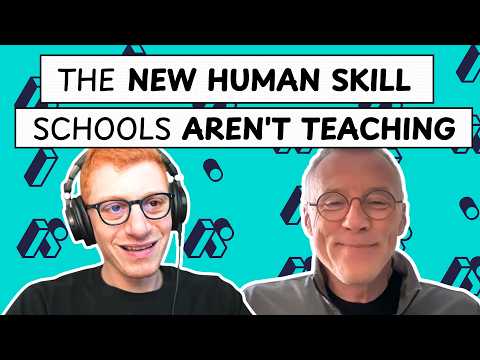
Kaleidoscope see podcasts as an ’engine for empathy’
Bring AI readiness to schools across the country
Free curriculum, tools, and professional development for K-12 educators.
What happens when you combine Hollywood-level storytelling with the intimacy of audio?
Oz Woloshyn and Mangesh Hattikudur, co-founders of @kscope_nyc, have created some of the most compelling podcasts in the medium by focusing on one simple truth: people love feeling smart, especially when learning feels like an adventure.
Kaleidoscope’s award-winning shows transport listeners from the Amazon rainforest in search of rare cacao to a Soviet space station where a cosmonaut finds himself stranded when his country collapses beneath him. These aren’t just podcasts – they’re audio journeys that hook listeners with compelling facts and emotional moments that make seemingly niche topics universally fascinating.
As we navigate the rapidly evolving landscape of AI and content creation, Oz and Mangesh offer refreshing perspectives on why human creativity remains irreplaceable. While they’ve embraced AI tools to streamline production (revolutionizing their workflow with transcription and editing software), they emphasize that technology serves creativity, not the other way around. The subtle imperfections of human communication (which Mangesh calls the "wobble") create emotional connections that no algorithm can replicate.
Kaleidoscope’s approach to podcast creation offers valuable insights for educators and parents who are concerned about how to engage students in an era of shrinking attention spans. Whether you’re a podcast creator, educator, or simply curious about the future of storytelling, this conversation will leave you rethinking how we connect with audiences in meaningful ways.
Learn more about Kaleidoscope:
- 0:00Introduction to Kaleidoscope co-founders
- 1:36Exploring Kaleidoscope’s podcast universe
- 4:12Crafting compelling audio stories
- 8:30The art of engaging listeners
- 14:04Teaching through storytelling
- 25:41AI’s role in creative production
- 35:20The future of audio content
- 45:53Authenticity in a digital world
- 49:23Building audience connections
Yes. Welcome to aiEDU Studios where we’re building either we don’t know if it’s a show, it could be a podcast, maybe it’s a YouTube channel. The goal is bringing interesting people on to talk about the intersections of our nerdiness, talking obviously about artificial intelligence and education, but also bringing people who are at the forefront of different industries, different spaces, places that are being impacted by and also driving forward innovation, artificial intelligence and can sort of help us sort of paint this picture of what the future really looks like because we hear we hear a lot about the future of work and the age of artificial intelligence.
I think most people don’t really understand what that means for them depending on their interests. And so to that end, we have not actually had an opportunity to invite folks in the media space in the creative space. And so joining me today are the co-founders of Kaleidoscope Mangesh Hartikador and Oz Valashan.
And we’re going to hear more about what they’ve built, what Collidoscope is. They are very much they have blazed the trail that aidu is just beginning. And so I’m personally excited to hopefully maybe we’ll have a little bit of I don’t know about that.
We will we will certainly be cutting all the instances where they’re providing me feedback and telling telling me about all the things I’m doing wrong. But yeah, thank you so much for coming on to the show and why don’t we start with just tell us a little bit about you know tell us about Kaleidoscope and tell us about what your life has been like over the last couple years as as you’ve been sort of building this this new studio, this new company. Yeah.
So Kaleidoscope is a podcast company. We love the audio space. We think there’s something so beautiful and transportive and the fact that you can be in someone’s ear and that connection that you have is so meaningful.
And and when Oz and I started this company, we we really thought that it was just an incredible way to tell stories from around the world and to almost treat it like an engine for empathy. And that stories were a way to just a incredible lens for understanding the world. So yeah, and so it it’s interesting because the even the project what we’re doing here, you know, a long maybe 60 maybe even 90 minutes if we have time to really get into it.
It’s really pushing back against the trend culturally that we’ve seen content go in terms of you we went from, you know, short videos to now literally like 3 seconds of just dopamine and almost no context. Brain rot as the kids in the classrooms that we teach. I mean, it’s literally like they’re they’re sort of like self-indulgent in the way that they talk about brain rot.
Well, it was the Oxford dictionary word of the year, I think. Brain rot. Yeah, it was.
But podcast and the type of and especially the type of podcast you do which is not just sort of I mean you do some talk shows right but you also do long form storytelling that that builds like series folks have probably probably remember the serial and sort of like how that brought sort of this like sort of storytelling format into the space and you’ve continued that work. Can you tell us about some of the stories that you’ve you’ve told in that format? Yeah, definitely.
So, like like I said, this is part of what we try to do is really value the listeners time and and really engage them and entertain them. And so, there’s a show about cacao and wild cacao that we did called Wild Chocolate. But the way we pitched it was, and it’s ultimately an environmental story, but we pitched it as an Indiana Jones of chocolate.
Or we did a story that was about a Soviet cosminaut who got stuck in space because the the Soviet Union disbanded beneath him and he was stuck there for 300 plus days. And and his only connection to the world was this ham radio operator in Australia that he managed to to connect with. Or I did a show that ended up being much more personal than I was expecting, but it was about how astrology is seen so differently in the east than the west and and and the ways that you know it’s it’s such a pseudocience here and and it’s it’s a way of life in India and and and these these stories that felt really fun and and emotional and like big adventures.
And in some ways, we were trying to trying to go against the grain of of at least in the beginning of of all the really long chat shows that that that were going on for like three or four hours. Like this these were things that were meant to pull you in and entertain you and at the end of the day leave you feeling smarter. Yeah, we were just talking before, kicking things off the about some of our favorite sort of YouTube shows and there’s this model just like bring people together, put them on some couches, IKEA couches maybe, and just banter and, you know, I think like I’ll give some props.
It’s still longer form and so there’s opportunities to at least, you know, dive into a little bit more depth of content. It’s not necessarily always educational content. But there’s a lot more work that goes into telling a story about cacao, which could be interesting, but you know, I could also see this be I mean, like you can imagine a lecture and something that’s informational and people obviously have short attention spans.
What are like what are some of the ways that you break past and you’ve been able to because also your shows are among the most listened to shows on Apple Podcasts and you won a few awards. Yeah. And and to be clear, like I I actually really value really long sort of interview shows and I I think different shows have different purposes, right?
And so, in the same way that sports radio, people would turn it on and keep it on in the background as as you’re like maybe painting a room or or you know, something to keep you company as you’re doing that, the commute to work where you might have 25 minutes or 30 minutes in a car and you want to be told something very clearly or or you want to learn specifically about markets or whatever, right? Like every podcast has its own flavor but but also purpose. And so I think we went in very intentionally with the idea of telling these really gorgeous stories and we tried to invest in the sound design in a way that other people hadn’t.
We tried to look at the space in in a way that especially like if you think about when we’d started this company it was coming out of the pandemic and so it it was people had been stuck in their houses for for a very long in the lockdown period people had been stuck in their houses. They’d still had this like tremendous wonderlust and to be able to place someone in a different environment through their earphones was something that we felt was really meaningful. And how many shows do you have out right now?
How many shows have we done? We’ve done more than 10. And we have another 10 to 12 coming out this year.
I think about half of the portfolio of what we do is going to be weekly more chat style content and and half is going to continue to be these highly produced cinematic stories. I mean in my mind what we’re really trying to do is always create someone’s favorite show, right? And and when I was at iHeart, we did a show called Call Your Grandmother and it was an 80-year-old host and a 90-year-old ho 90-year-old host and they were like a hoot and you wanted to spend time with them and you at the end of the this like half an hour with them, you reminded how much you love your own grandmother and you know like and and for for someone like me whose grandparents have all passed, it was just such a pleasure and to be able to create that space.
You know, there’s so many flavors of show to provide that I I think and there’s so many lanes. I don’t really think of other podcasts as competition, right? I I just think there’s space to to to really sort of provide something beautiful and and and let audiences find it and evangelize it.
I I really do think good content makes its own luck. So, I want to talk about this this format and we’re going to go a little meta and maybe you can even imbue some some sage wisdom on me and my team as we’re trying to figure out how to build our own. Again, I really don’t know if this is a show.
I think like right now I’m thinking I’m thinking about it more because and you will be the first to tell me right that like when you pitch an idea for a show there’s a really coherent sort of like framing. You have a sense of the format and we’re still experimenting and so I’m trying to give myself a little bit of you know wiggle room to really kind of see what works and see what works for it’s fun I mean you find that you find the format in in the doing right so you don’t have a firm launch date is quite nice because you can iterate and iterate until you find exactly what works for you and then and then take that out as the product or you can launch it and iterate it in progress right I mean you see especially these more chat driven formats you see how much they evolve from episode 1 to episode 10 to episode 100 I’ve only listened to three of the shows that you’ve released, the first three. Wild Chocolate, Skyland Drive, and The Last Soviet.
And, and yeah, those were incredible. Also, The Last Soviet and amazingly narrated by, Lance Bass, who I never realized he actually served in the it was like a Russian sort of cosminaut summer camp. He he was prepping to go to space and he he spent time at Star City, learned Russian, did all this testing.
It was pretty incredible. What I think what stood out to me is I never had an interest in chocolate. In fact, I don’t really even like chocolate.
Although I did I do have the the the the collab that y’all did. That chocolate was amazing. I actually developed an appreciation for chocolate.
But basically it was not the type of show I would normally have committed to. But there was something about being transported to like literally being in the Amazon, the the interviews with you know people in these remote villages. And it it brought me back to this Yeah.
This sort of like this age of like much more adventurous like the the the value of media was sort of like bringing you to places that you couldn’t necessarily go yourself. Yeah. And I’m someone who I I sort of I respect, you know, the Marvel universe and I respect sort of, you know, these like big blockbuster movies.
But it does feel like there we have a lot less of that culturally now. You know, you’re sort of or you’re transported to 50 or 100 different parts of the world in a span of like two minutes on Instagram or Tik Tok and you don’t you don’t really connect. There’s no there’s no opportunity to actually connect and sort of hear the almost like the tenor of this old woman’s voice and sort of like the gruffness and you can kind of tell that she’s been like working in you know in this in this trade for you know 30 years and like the fact that you can hear that in her voice is there’s sort of a subtlety to it and I I’m curious if you feel like this is a I mean do you feel like this medium is is is underappreciated I mean how I mean everything now feels like niche niches everybody has their you know there’s folks spending 20 hours a watching people play video games, not playing video games, watching people play video games, right?
And so, and actually my favorite, so my favorite niche is it’s a YouTube channel called Townson and Sons. And this is this guy John Townson in Indiana, and he, is a reenactor, but his specifically he reenacts 18th century cooking. And so he has the whole garb.
He’s built like a hut, and he has all the materials, and he like teaches, he like looks into old recipe books and like cooks 17th or 18th century cuisine. And he’s millions, like 2.5 million followers. His videos get hundreds of thousands, sometimes millions of views.
And I love that. I love that that’s actually like part of what the internet has done is you don’t have to have like the best show that literally every single person is talking about. You have to figure out how to hook, you know, just that right type person.
And and so you have three shows that are kind of all over. I mean, like, you know, chocolate, space, astrology. But but I I think it’s one of those things that people don’t know what they’re interested in until they’re shown, right?
And so one a a show about chocolate probably you wouldn’t expect that it starts in the Amazon with a journalist circling because he can’t land a plane and and it finally lands and and and the whole and they finally patch find a patch of land to land on and and they the plane comes to a stop and then four men with guns come out and tell them you know like this is a drug lord’s land and you shouldn’t be landing here, right? I mean, like that isn’t the expectation of what a chocolate show should be about, but also it is engaging, right? And and I I I think that I I certainly like, you know, Netflix has shows about glass blowing that like I wouldn’t have I don’t care about glass blowing or I don’t think I do, but then I watch, you know, like I don’t really care that much about baking.
I watch Great British Bake Off all the time, you know, like and I do care about it, you know, like there there’s so many things so many things to appreciate and so many ways to appreciate it. And I feel like you just have to be led in in the right way. See, not for nothing.
I mean, the connective thread between those three shows is their quest adventures that relate in one way or another to science and in some case technology. So with wild chocolate, you have these people who are so obsessed with this pre-Colombian semi- mythical cacao in the Amazon that can only grow if it has enough canopy coverage that it’s in the dark for most of the day. And these people risk it all and bet their whole life savings on trying to find these beans, right?
And so you go on this adventure with them and in the process you learn about the Amazon, you learn about the history of cacao cultivation, you hear about it role in pre-colian culture. In the case of the last Soviet, you have a guy who goes to space is in the mere space station. The Soviet Union collapses beneath him and he’s faced with a choice.
Do I come home and abandon the mere space station to spin off into space or do I wait here for as long as it takes until someone can bring me home because this mere space station is the last redout and the final pride of the of the country and the empire I’ve given my life to. And again, in that you get to the history of the space race. You get to rocket technology, propulsion technology.
In the case of Mangash’s show, the astrology show Skyline Drive, this was in a sense a skeptics’s guide to, you know, a spiritual topic because you your family obviously believed believes in astrology. You were yourself a skeptic going into the show. Yeah.
I mean, I I I think it’s it’s one of these things that I don’t believe in astrology, but astrology has happened to me, right? Like my parents met because their they were introduced to one another because their charts matched, you know, and it was almost like this dating service where like they could only their family only introduced them to people who who they matched up with and and they dated for a bit, liked each other, you know, ended up getting married, but but I’m only here because of astrology in this strange way. And so and you also find astrology whether you believe in it or not has affected the world drastically in that one search for understanding astrology led to an understanding of astronomy right it was only through like it’s the desire to understand the future that led us to like investigate the stars closer but but also you know astrology is what convinced Reagan to to for the nuclear disarmament have talks with Gorbachev.
Like it was his astrologer who was in his ear who said like now is a great time to do this. This is the time. This is the reason.
And and he was such a believer that like you know if if you look at the times of his inaugurations or the times he’s sworn in like they’re at astrologically significant times and moments and like and and similarly Boris Yeltson Midon like all these people you know it’s it’s one of these things that when people need hope or they’re in grief or they need like consoling, right? Like like people turn to the stars in the same way they turn to religion. And and so when people don’t know what to do, it’s it’s it’s convenient.
And so there there are teams in San Francisco, baseball teams, that don’t know which players to pick in in drafts. And so they use astrologers to to guess which one will have the better longevity with the team. And and like we don’t see this.
It’s invisible. But when we’re rooting for our favorite teams, we don’t know that actually astrology has played a part. Okay.
So So you talked about in making obscure topics engaging. We work with teachers every day who this is their daily struggle. Whether they’re teaching linear algebra or the fall of the Soviet Union to actually come up with an example that maybe is relevant or the scarlet letter.
You know, these are some things that students occasionally will sort of develop an interest in, but for the most part, kids are looking out the window waiting for the bell to ring. And I’m curious like is there anything that teachers can learn from the work that you do telling stories? I think one one of the things I I learned along the way is that people love feeling smart.
And and I I think that I think part of what we do is try to infuse our storytelling with a lot of joy and a lot of quirkiness. And and the weird facts on the edges often are the things that end up pulling you into stories. And so something like the last Soviet was was I believe it was like a one-off fact about a Soviet that had been stuck in space that that your friend told you about.
And then we were like, wait, that can’t be true. And then we looked into it and then we dove into it and then we realized, oh, there’s this incredibly rich story. And I feel like if you can figure out what that first fact is that gets someone curious, that’s fun to repeat, right?
Like whe whether it’s the fact that like I I think Belgium tried to use cats to deliver the mail you know and and they equipped 37 postal cats with with and and the whole experiment was a disaster. But but or or that like you know there there are pirate ships that that ran out of cannonballs and won battles with Edom cheese or or you know like there there’s so many ways into history and math and science and storytelling and even like Pythagoras is more interesting when you know he had a cult and wouldn’t eat beans and like you know I I I think there are so many aspects that let you feel a little smarter and and if you can walk out of a room like with that sort of joy that that sort of sense that you want to evangelize a topic like that that makes that makes learning fun. Mary Poppins spoon full of sugar.
We had a meeting yesterday with the former director of the Exploratorium here in San Francisco. Oh, very cool. And he had some interesting insights for us.
One of the most fascinating things he told us is that the number one complaint about the Exploratorium is it’s impossible if you’re a parent to get your kids to leave. But he he he had this interesting phrase that strategy equals sacrifice. And so he basically said you have to decide where you want to be.
Is it engagement or is it information that you want to lead with? I think in in a culture of Tik Tok and like dopamine highs to be an effective educator you have to figure out how to meet people at the place of engagement and then you know educate them following that. I think coming in with the assumption that people want to know facts to improve themselves has you brings you a very narrow audience of students in this day and age and so far be it from us to give advice to teachers but I think like without without you I think thinking about not being allergic to the word engagement even though it’s a little bit of a dirty word given the you know the Tik Tok of it all is crucial to winning any kind of audience.
I mean, I I I see it with one, my mom was a preschool teacher, and what she was so good at was finding out what each kid was interested in and then tailoring the subject to them. And so, she would she would make the room feel like an airplane and give everyone passports and take them to Egypt and take them to various places and like and you know, I don’t know where you got it from. But but you know, at the same time, like she would get these preschoolers and teach them like, "Oh, this is this is how you’re going to fingerpaint like Paul Clay.
This is how you’re going to fingerpaint like like Van Go. This is how you’re going to do like Monet." And and it was just unbelievable that these kids would walk out out of these classrooms like feeling so confident and so good and and that they could a lot of times like older siblings would cry because like their younger kids knew to more about the solar system than they did, right? And but but I saw it with my own kids where where like this this incredible teacher brought worms into the classroom as a class pet.
She’s like, "Everyone else has one pet, but we’ve got 500 here." And like, and they learned everything. You know, the the places where disciplines mix and they can talk about the environment, they can talk about biology, they can talk about like you know, food systems and all these things. Like I I think that kids are sponges and and they they do want to learn.
You just have to show, you know, you just have to engage them a little bit. And and I I realize that sounds easy or something. And obviously a teacher’s work is is is the hardest thing in the world.
And and like I mean I I think in various places like my journalism teacher in in high school is the one who who made the intro to an investor who who invested in mental floss and and he invested in kaleidoscope, you know, and and like I I I still communicate with my my like teachers from third grade and sixth grade and people who listen to Skyland Drive. And I mean I was really lucky in that that there was such a focus on creativity in my school and the creative applications of sort of the inquiry based learning we did. Yeah, this is a common thread in the education space I found is that when you talk to a lot of folks who’ve been doing this work and it’s and certainly that work of teaching is thankless and underpaid and yes you get summers off but it’s even the summers are not as long as people assume.
Yeah. And and a lot of them have these sort of like origin stories that start with that one teacher. Yeah.
That had a trans transformational impact in their life. And you know, yes, it is easier said than done. And you know, preschool teacher, elementary school teacher, fourth, fifth grade, there’s a lot of scope to be creative and sort of like bring these different experiences in.
As you go further along and even when you hit fifth grade in some cases, teachers are starting to be burdened with standards. Mhm. And all the boring content stuff that they have to teach.
Yeah. And so that is often the challenge. It’s not necessarily that teachers are I mean not creative or just don’t realize that that and so it’s it I think I think it’s much easier when the kids are younger.
I mean like especially as you’re teaching to tests and like etc. But but but but there’s still so much space. Yeah. So, let me let me so I I I say all of that because as you were sort of describing some of these ideas to me, I was trying to think about like how could a teacher kind of like tomorrow take that and make it actionable.
And it might be hard for a teacher to figure out that weird quirky connection to whatever it is the lesson that they’re teaching. We don’t normally p push AI as a tool that teachers should be using every single day to like across the we don’t believe AI should be replacing the work of teachers. But it occurs to me that this is actually a really interesting use case.
Yeah. What a great you could say you know I have student A who’s this these are their passions and student B these are their passions and student C these are their passions. What what what are some suggestions on the best way to engage them on the topic at hand?
And I think that would be a perfect use case. I think it would be a perfect use case. And and the call out is still that you need a teacher to, you know, some percentage of the time, probably a big percentage of the time in that specific prompt.
It’s going to hallucinate, make it up. So again, not replacing the work of teaching. You’re still going to have to do a little bit of homework, but I think that’s the sort of thing that could make this a lot easier.
And so when we think about how does AI fit into the classroom, you know, people say, well, it can make learning more engaging and more personalized. It just occurred to me that this is maybe a really like a tangible example of that. It’s it’s it’s subtle, but it actually to your point like the the point is the hook.
You know, you spent a lot of time I I assume like significant amount of time thinking about like that first episode. Absolutely. It’s always the hardest one.
So much and and but but I I Yeah. Ex. Exactly.
I don’t want to be dismissive of the work that teachers do because I I saw it firsthand, right? Like and and also my mom used to make us she’d pull my dad and me in to like turn refrigerator boxes into like various things and she’s like, "Well, this one’s a castle." I was like, "Amma, we just made a" and she’s like, "No, no, that was a rocket ship. This is a castle.
This is something else." And like like but but I was constantly helping her cut things and like make things and worksheets and whatever. And like obviously that work is so important, but but I I I I think like the benefits to the kids and the way kids walked out of that classroom so confident. Like I think I think that’s what I was fascinated with was like these these kids that really had a stronger sense of self because they knew things and then could go into kindergarten where the socialization is really hard, right?
But but if they’ve got the academics covered then like the they can focus on the socializing and and one of the ways I sometimes like to prepare for interviews is to is to you know open an LLM and say like imagine you are a Goldman Sachs analyst and you’re going to interview this person like what are your top three questions now imagine you’re the editor of Wide magazine you’re going and now imagine you’re you know Katie Kurik and so basically to to to to to have the LLM like imagine its way into different like interrogation or questioning approaches and then kind of use that to piece together. Okay, what is the most interesting way to engage this person? I think I I think that’s what’s what’s really fascinating is like the the way you get so many options out of I won’t say what should I ask this person.
I will say provide inspiration on an approach and I’ll choose between suggested approaches. I mean I I we were talking about this earlier that like I have a friend who started this company called Pseudorite and it’s to help writers particularly when there’s like writer’s block to give you like options of where your story could go and that inspiration or taking what you’ve written and I had this friend Daniel Alakon and and he said that he took a map and he like redrrew it and tried to imagine a landscape and like had to do all this work to figure out like what this imaginary land would be. But AI can do that for you, right?
Like it can create like what your fantasy visuals are to inspire you and to to give you even more clarity on what you want to do. And so like I I think there are all sorts of ways of creating options for yourself when you’re unsure. This is a a beautiful segue because I I wanted to have an opportunity to ask you about this this question that you’ve already sort of led us to, which is what are the ways that AI either is helping you do your work or could help you do your work.
And before we dive into it, I I just want to sort of set the stage for like the type of folks that might be listening in. You know, sure teachers, maybe some administrators, but al also parents, right? And I talked to a lot of parents who are like my kids.
In fact, our director of communications is his son loves creating art. Yeah. Not like YouTube video like like literal like draw like collages and painting spray paint.
We we get questions from a lot of parents that are like my kids are really interested in yeah art, media, design and and they’re reading the news. They’re seeing maybe they’re playing with Dollali or Midjourney and you type in one sentence in like not even a minute but like five seconds and you get this very compelling painting photograph 3D rendering. And I think I’ve actually seen some audio books on Amazon now that are narrated by AI voices, AI podcasts.
There’s AI. Yeah, there there’s there’s AI podcasts. And so to the discerning parent, the the question that that we get is is is there going to be space for for creatives if AI is going to be able to do all this stuff that we traditionally associate with creative work?
Is this kind of a dead end for for my kids and should they be learning something else? Maybe they should be learning AI stuff instead of instead of doing art. And before I weigh in with how I respond, I I’ll I’ll tease it and say that I I’m veheminently not aligned with that perspective.
I I think that there is this important room for creatives, but you’re on the front front lines of this. And we’re far enough along now. Where Chad GBT came out the end of 22.
So, it’s been what, like two and a half, two two years and some change. Okay. Is it has it actually changed the way you work meaningfully?
Has it changed the way you hire? Is it is it changing the way you’re thinking about your strategy? Why don’t we start with like have are you using AI dayto-day?
Did you use AI in the last week? If so, how? Practically speaking, we use AI all day, every day.
In fact, it’s completely integral to our production process. Not in the form of telling us what to say, but in the form of actually efficiently editing it. Me, you want to explain about the script and how we use it?
Yeah, we use a program called the script and we import our files into it and it basically transcribes all your content. It can filter out sounds. It for like if our there’s mic bleed, it fixes that.
And it allows you to edit like you’re editing a text document. So, so you just delete a sentence and it cuts it from the audio. You don’t have to, you know, you don’t have to any audio.
And now to have a perfect product, of course, it’s not not good enough. But to to be able to go from a lengthy interview to an effective rough cut, you can do that as easily as you can edit a Google doc. Whereas even 3 years ago, that would have required.
What was what was it like before you had to script? Before that, you would have to send the files to a transcriber. You would send which cost like a dollar a minute.
I mean, it was expensive. Yeah. You’d also send too expensive to get stuff when when I started podcasting in 2019.
It was too expensive to get all our audio transcribed. It was too expensive to get all of our audio transcribed. Can you believe that?
So the the production flow was we would literally decide is this interview important enough to spend $300 to get transcribed to figure out what the best moment is without listening to it for three hours. And also it often wouldn’t be you listening to it. It would be someone else listening to it and you’d hope they’d make the changes that you want.
Yeah. And then you’d listen to it and then you look at the paper and you try to consolidate those two things and try to meet somewhere what’s closer to your vision. Yeah.
Versus, you know, I do a show called Part-Time Genius. It’s a very quick show, but but I look at it, I make the tweaks that I heard as I was recording something. I I knew this sentence was wrong.
I knew I made a hiccup here. All these things. And then I send it to get mixed and mastered and and all the other steps that used to all the like QC the quality control that used to take place have been eliminated.
Like it’s a much much faster and more seamless process. But this is a great example. This is not like we’re not going out and saying like or sometimes we are but in this case not how do I use AI.
It’s more like it’s not we don’t think about as using AI. We think about it as using an application. In fact we’ve forgotten how bad it was or how difficult it was before descript.
I think you know one of the other areas obviously creative inspiration and I’m super super happy and relieved to report that I think AI does a great job of summarizing information obviously often with hallucinations. It has no ability to write with voice. And even like notebook LM, right?
It’s pretty interesting. Like it can make a pretty competent two-way conversation podcast between like a male voice and a female voice. It’s also entirely reliant on what you feed it.
So like if you just say like here’s 10 articles about like the Super Bowl, it will do a really boring job. Whereas if you say like okay here’s 10 articles about like the Super Bowl in 1963 and I want to understand how this social phenomenon affected you know the sports environment you might get something interesting but at that point you’ve done a lot of the creative labor yourself right so you know this I think coming back to your question about technology and and and what should parents think about for their children I remember so vividly like the 2010 era learn to code like forget the humanities learn to code thank god like that was the worst advice ever right and similarly now like you know I I read Jack Clark, one of the anthropic founders newsletter a couple of days ago, and obviously he has like a vested interest, but his his main point was like the winners of the future will be the most curious people, the people who keep finding the most interesting ways, the most forward thinking ways to ask LLM’s questions. And how do you get to be a good question asker?
By feeding your curiosity as a child, as a young person. And so I I I really think that like the future is is is not about you know getting being like oh well AI can like make an image so why would I become an artist? It’s it’s really how do I develop into the type of person who can think creatively about how to make the most of technology to serve me and my community and my society.
Yeah. What I’m hearing is the the type of work that you’re describing that’s being replaced. I don’t think anybody is in school thinking I want to be a transcriber.
I don’t think anybody’s in school thinking, I want to spend 12 hours a day in Photoshop, you know, removing objects from the background of of videos. And it was meaningful work for people for decades, but but there but yes, I I I agree. I mean, like like I don’t think that was anyone’s ambition, right?
Yeah. So, there there is a a question about what what h like where do those dislocated workers go? There’s this sort of, you know, the talking point is we’re going to empower them to do more interesting creative work.
The reality is, you know, there are sort of there isn’t that there aren’t that many roles at companies like Kaleidoscope to do creative work. And so I I want but I want to put a pin in that conversation because I I want to actually hear more about Sorry. C can I just say one one one other thing is that like most people don’t know this, but our our album art for our first six shows was all done on an early version of Dolly.
I mean like the the the art was done on it and then we got an artist to to draw over and highlight certain elements and stuff but but the the starting point was was AI. Okay. So that is fascinating because when you first told me that, I was incredulous cuz I I sort of pride myself at being able to spot AI art and my my like Spidey senses didn’t tingle when I was looking at your album art.
It does for a lot of other stuff on like Spotify and Apple, but I understand why now because you you also brought in that human component to take it to that next level. And I think that’s that’s to me this like really interesting takeaway which is the there’s always going to be this need you know everybody’s going if everybody has access to like this baseline of content this sort of like common denominator of just AI generated like whatever there’s going to be so much of that that I think people are going to actually seek out and like identify quality and the only way to do something that AI can’t do is to tap human potential and human creativity has it impacted hiring? I mean, like, have you I guess my question is, have you hired anybody just to like be the AI tool user?
Because I think that’s what some people are saying is that, oh, you don’t need to learn you don’t need to don’t study art, just learn how to use AI and prompt engineer. And I’m kind of I’m I’m interested in that because I I I’m I’m curious if that’s the type of is that is that a job posting on Kaleidoscope’s career page? I don’t think so.
I mean I I at least from my perspective we are looking for people with voice and outsider ideas that are super creative and and even when I was at iHeart a lot of people would just hire people from the radio industry to to come in and work because like this is versus like we hired musicians who’d never done podcasting. We hired like you know people who were in all sorts of other fields. There was someone who used to like help kids who were ill create poetry and art and but but like I think what we’re looking for is really creative smart people who have a point of view who can learn the tools and use the tools to to advance our own sort of point of view or creativity.
Yeah, I think we’ve we’ve had the same experience like we don’t really use AI very much for curriculum development. If if you have a certain level of quality, it’s actually it’s very hard to get I mean I’ve I’ve done I I’ I try I’ve tried using Chad GBG to write stuff. Same.
I hear people saying, "Oh, it can write emails. It can write press releases." Like I I disagree. I think that it can I think if you’re trying to write let’s say a 100 blog posts a month, Yeah.
Then yes, Chad JBT is probably useful. I don’t know why you would want to do that if you’re trying to write maybe for SEO, right? I mean, I think that’s that’s going to be a big change, right?
Is like like people don’t like written content on the web except for from super prestige publications like I think or in forums like Reddit and stuff is like losing very rapidly losing its authority which I think is a big opportunity for audio because yes you can make a deep fake of my voice and theoretically have ChatGPT write something then have the deep fake read my voice but like you can hear that pretty easily and I think the opportunity for podcasting the reason we had this podcast election in part is because it’s a very trust trusted medium and I think will retain a moat in that respect. I think people looking for guidance. You you’re going to be way less swayed by the top 10 Google results 6 months from now than you were a year ago.
We’re in a bit of the the wild west right now in terms of of media. I mean I think that there’s sort of a definitive shift away from linear TV. We’re using a lot of industry speak.
You said moat. I’m going to linear TV is sort of just like broadcast television, cable news, cable channels and you know people were moving to Netflix. I honestly YouTube especially YouTube premium without the ads is like totally dominated the way I consume media.
Obviously people are on Instagram, Tik Tok. And that’s especially pronounced in the new generation, right? Like Gen Z, Gen Alpha.
And I’m so so maybe we can close with a little bit of sort of meta introspection about sort of what we are doing here at aiEDU Studios. And I I’d like you to sort of I’d like your take on this in terms of what we could be doing with the format. Because one of the things that I found is there’s there’s now yes there’s this shift to sort of this open universe of content.
But not every niche is actually like fully like served. So you identified long- form highquality narrative storytelling where there were really I mean who else I mean there was obviously Gimlet Media which what are some of their big shows? Was it startup was one startup reply all heavyweight mogul there was I guess NPR and and like there wasn’t much else right it was it was I think I I I think to me what is is partially so so meaningful about all these things right and and you saw it with Ira Glass in this American life was that what made it possible for someone like me to podcast was he was imperfect.
He allowed his stutters to go on air. He stumbled and and sounded like a person you were actually having a conversation with. And that lent the show a certain authenticity and and a little bit of roughness around the edge, a little bit of like I I know you’ve talked about this like like a little bit of wobble, right?
Like like and and I think that when we look at YouTube, when people are in their apartments and podcasting, when you have Tik Tockers in their cars and showing you that they’re passionately talking to you about something, but you know that it’s not as polished. It’s coming, you know, sometimes it’s performative, but but often there it there’s a bit of heart to it, right? And and I I think to me that’s what you never get from the AI version of your voice is that sincerity, that authenticity.
And and those are words that are overused and abused often. But I also think when you’re moved by something, it’s because of that. Yeah.
I think this is the this this idea of authenticity seems like maybe one of the biggest undercurrents that is going to shape the way that we consume content, right? Because I would actually I would actually push back. I think yes, you can you can sort of hear you can tell when there’s an AI voice.
Now, I’m just going to assume that in like let’s say 5 years, if we’re going to go really far out, maybe sooner, it will probably be imperceptible. And yet, even if it were imperceptible, I still you can at a certain point AI is just it’s very same. Art I see this with art all the time.
It’s like the reason you can easily spot AI art is because it actually can only do a few different sort of flavors. You have like the 3D rendering version, you have sort of like, you know, imitating artists. Really bad at sketches, you know, it’s like there’s a lot of And so I I think in any kind of form of media, people are eventually going to saturate with sort of like whatever that sort of average output that the AI can do.
And we’re already seeing your point about this authenticity is interesting because even before AI sort of like complicating it. Yeah. I mean I remember talking to some companies who had been investing in stuff like this in like sort of like video series and they spent a ton of money on like Tik Tok ads and like super like brought in like some like these like really famous directors and you know cinematographers and they didn’t perform well because what they realized is that people like didn’t want to see polished content.
They actually were more drawn to something that felt sort of human. Yeah. The other the other thing that we’re the other big idea for this is in a lot of spaces and so we’re sort of straddling like we’re not sort of trying to reach kids with this show.
Parents, yes, teachers definitely, but also administrators, people that work in the philanthropic sector that are trying, you know, decision makers within the K-12 and education ecosystem. Very niche, very specific. There certainly aren’t very many, you know, like shows or YouTube channels or like rabbit holes that you can deep dive.
And I know this because I have pursued as many of them as I can possibly find. And it’s, you know, it’s like old lectures that, you know, different universities put up. Sometimes the audio is like cutting out half the time.
So part of this is the idea is create like a space for for people to nerd out and go deep in like the specific sector and and sort of like angle and dimension of the topic that we’re pursuing. But it’s also to try to break out of I feel like where a lot of the the the discussion that happens in like any any kind of space. It’s happening often at conferences on panels.
Yeah. And I I really believe that the age of like the panel is just it’s so it’s so dead. I mean I feel like when you sit down and just hear people talk on panels and you get like 10 or 15 minutes at at most from any one person and then you’re off to the next thing and it’s all feels very scripted.
My my instinct is that this format is actually a much better way to like do knowledge transfer from really interesting smart people. Like give them like a lot of time to actually go deep. Like have the conversation be a little bit more unstructured, right?
And allow yourself to be sort of surprised and and and not sort of just try to I’ll just finish. Yeah. Allow yourself to be surprised.
What so you mentioned that you’re actually working on some like is it is it talk shows or like can you tell me more about the format and anything that you’ve any advice that you can impart on us as we’re trying to think about sort of like how to like what to do with with this idea that we have? I just I just taken over a podcast called Tech Stuff which is iHeart’s flagship technology podcast been around for 16 years I think driven tens tens if not 100 million lifetime downloads and has a large and loyal audience and so you know the question here for me and my co-host Cara Price was how how do I or how do we serve this audience make sure they feel like they haven’t just had new hosts foisted on them but they they feel heard and they want to stick with us because obviously, you know, retaining the audience is is a really important goal for us. And so we just started a a Gmail account, tech stuffodcast@gmail.com, and constantly soliciting feedback and we’re getting some, you know, interesting, supportive, sometimes pointed feedback from the audience.
And I find there’s nothing more valuable than that. And to your point, like the K-12 world that you’re talking about is relatively niche in a sense that like you can probably, you know, there’s probably fewer than 5,000 people or maybe 20,000 people. I don’t know exactly how many people, but you could proactively pilot content, put it in front of those audiences, get their feedback, and allow them to collaborate with you and build with you to make this asset as valuable as possible for them.
What’s an example of some critical feedback you’ve gotten? Good question. I think one of the I’m a former TV news producer and the history of tech stuff, the previous iteration of tech stuff was very much explainer content that was not tied to the news cycle.
And I’ve leaned a little bit more into like explainer plus news. And some people are like, I’m saturated with news. I just want pure explainer.
For me, it’s hard to cover tech in 2025 without some news. But you know that’s a preference and I think there is there is an audience who really want old school you know explainer content you know but that’s not my special skill or my passion. So it’s like well how do I serve that to a certain extent but match it with what drives me as a creative personality.
The one I I I’d say two sorry I’ll say two different things. One is about audiences and I think it’s so important to both listen to your audience and reward them. Yeah.
And and try to meet them where you can help them. So this is from my previous experience running a magazine called Mental Floss. We were, you know, I I started out of college, had no money that like my business partner and I were working part-time jobs.
We were doing this in the evenings. We were like doing everything we could to get this magazine out. And this woman wrote us and said, "You know, I’d love I like this, but when are you coming out with a a large print edition?" And and my friend Will and I were saying like, "Large print edition?
We can barely get this edition out." And and then he sent her he was like, "Look, we’re not going to have a large print edition, but we can send you word documents. You can print them out at whatever size you want." And that Christmas, she sent out large font size. Large font size.
And and and that Christmas she gave like 30 or 40 subscriptions of the magazine, you know, and I’m sure with every one of those subscriptions she told people the the host said I mean the the editors of this magazine reached out to me, wrote to me, responded, you know, and I think that where you can create connections with your audience, where you can help them, like the that word of mouth and evangelism is really really meaningful for for for a business. That’s obviously not possible for everything. The other other thing I’d say, you know, we were talking previously about how important it is to think critically and to to be creative as we’re going into this world of AI, I also think it’s really important to learn how to edit and to pair down and to curate because I think that even though these three-hour podcasts are great, I think there are lots of tangents.
Time is is is a a commodity for people and and and the the fact that you know I might not have three hours, but I want to know the the most important parts. The Cohen brothers when they did a director’s cut of of their movie Blood Simple, it’s the only director’s cut that’s eight minutes shorter and it’s a better movie, you know, and and so like I think there’s value and you know, you can provide the shorter version and extended version, but I think that thinking about what your listener really wants always and how you can deliver that where it matches your vision of a product is is really important. All right.
Well, I guess we have to listen to our listeners. Oz Manash, such a pleasure having you both on. Thank you for peeling back the curtain a little bit.
I have so many more questions. I hopefully we can cover it in dinner.